Welcome! I am Lorenzo Speri, a postdoctoral research fellow at the European Space Agency.
My work focuses on enabling maximum science return from astronomical data.
Explore my website to learn more about my research.

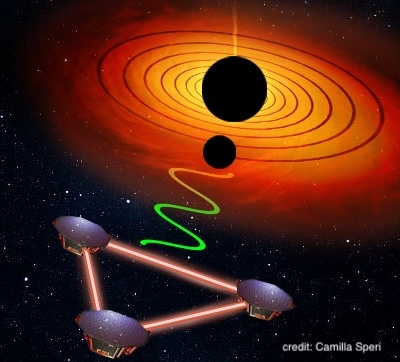
Environmental effects, such as accretion disks around black holes, can significantly influence the evolution of binary systems. My research explores how gravitational waves—emitted by compact objects spiraling into massive black holes—carry imprints of these environments. By analyzing future observations of the LISA mission, we can probe properties of accretion disks and gain new insights into their physics.
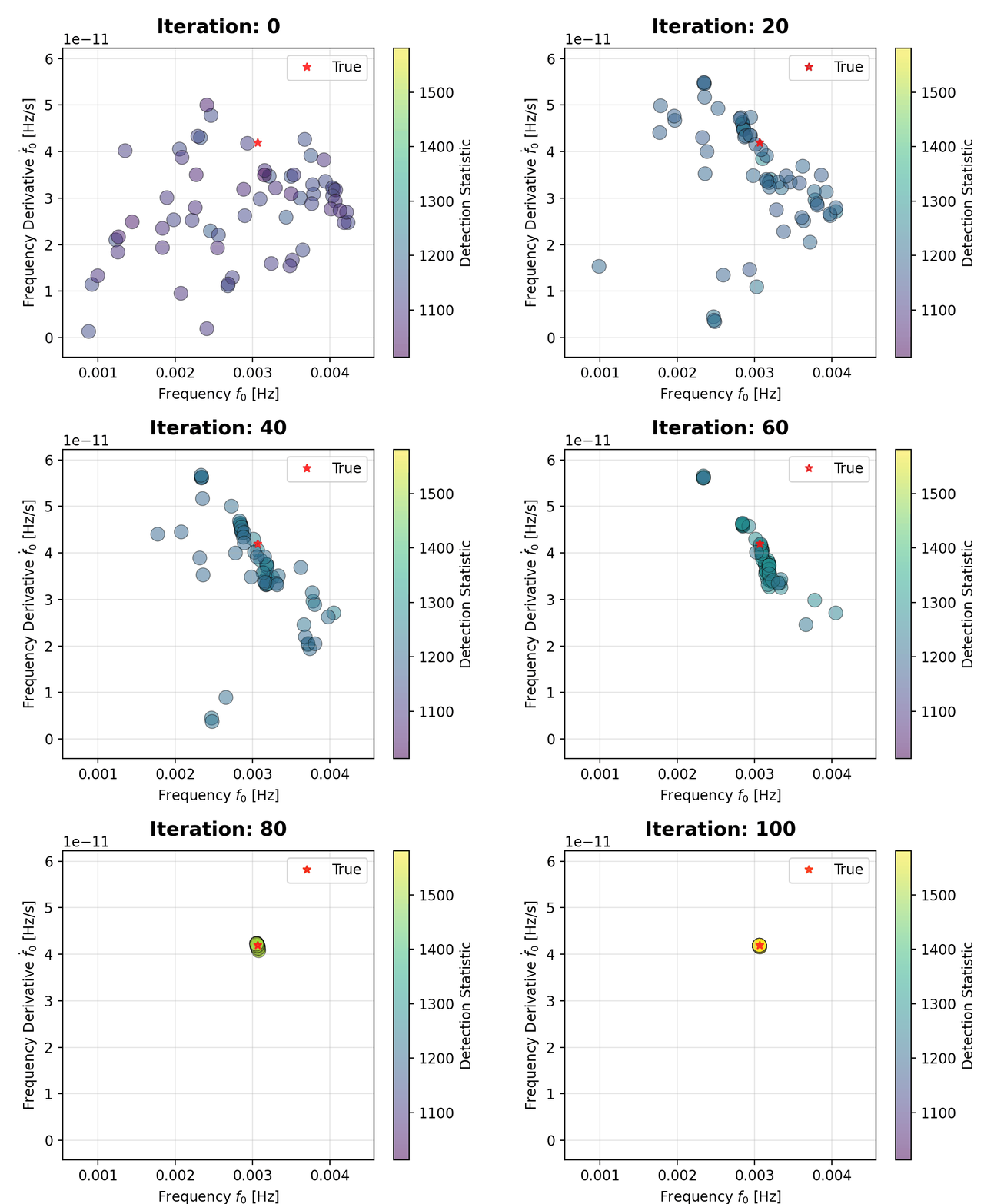
This animation demonstrates the optimization process used to search for gravitational wave signals in the data. The goal is to find the maximum of a detection statistic function across the parameter space—such as the frequency and frequency derivative of the signal. To achieve this, we fill the parameter space with walkers, shown as colored dots. The color of each dot represents the value of the detection statistic. Each walker explores the parameter space, collectively searching for the highest value of the detection statistic function.
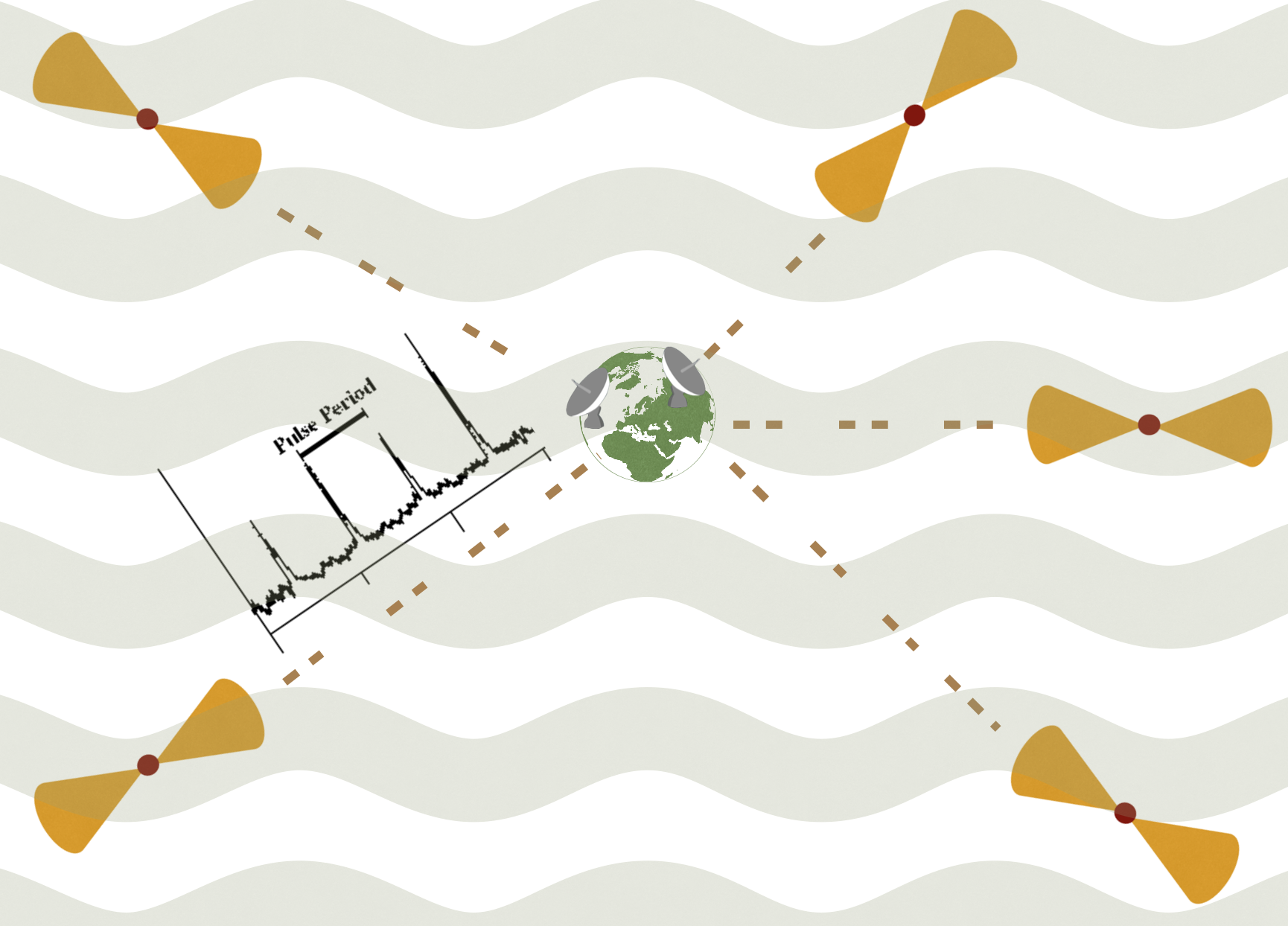
The image represents the concept behind pulsar timing array experiments. Pulsars in the universe act as extremely precise cosmic clocks, emitting regular radio pulses. We monitor the pulse arrival with radio telescopes and search for deviations in their arrival which are consistent with gravitational wave signals. I develop trans-dimensional inference methods to search for the inspiral of supermassive black holes in the European Pulsar Timing Array Data Release 2.
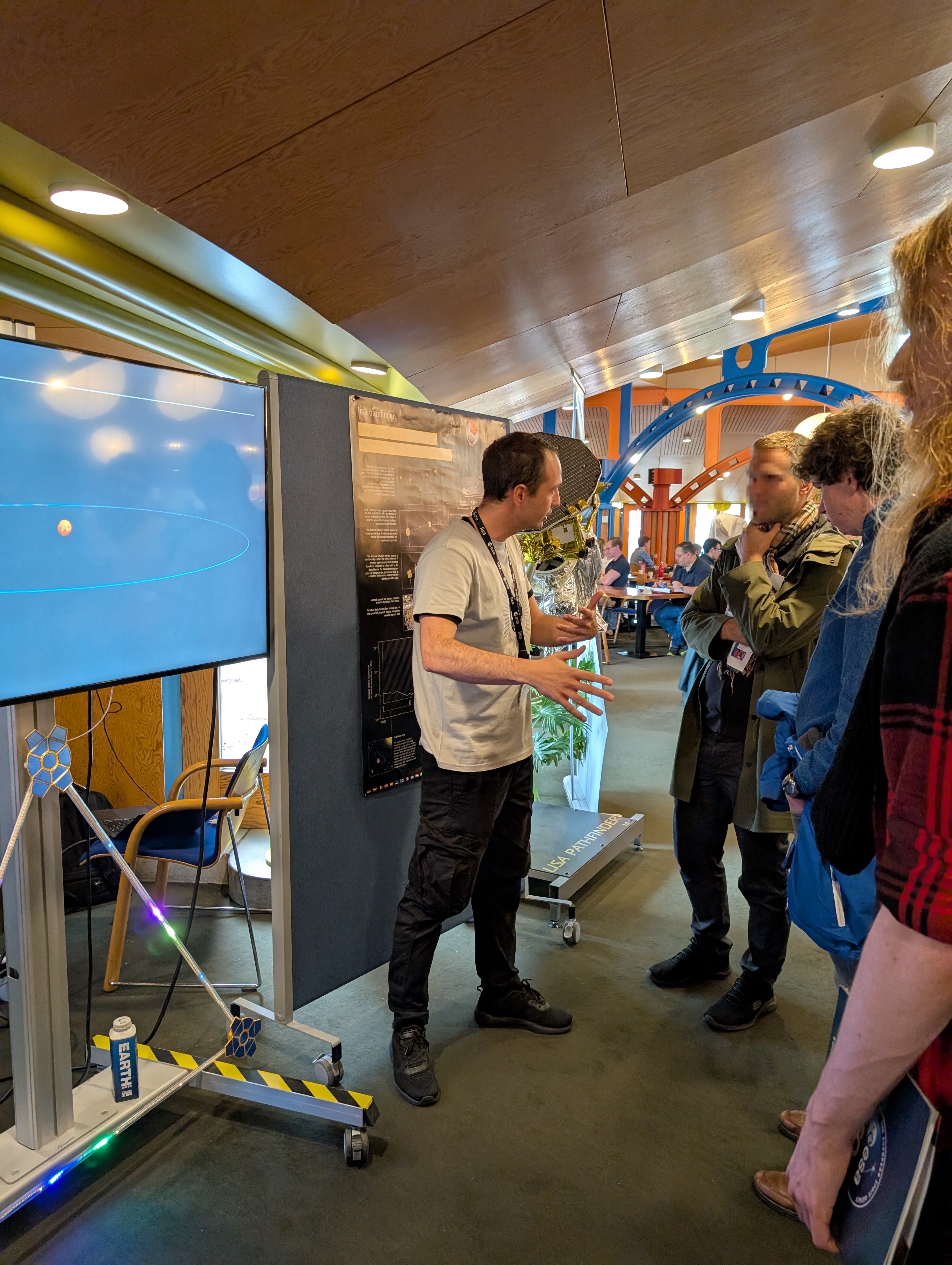
My research focuses on advancing gravitational-wave astronomy through novel data-analysis methodologies and waveform modelling. I develop statistical and computational methods for science harvesting of the LISA mission and the European Pulsar Timing Array data.