Publications
My research focuses on developing advanced methods to extract valuable insights from gravitational wave observations. I specialize in data analysis for LISA, Pulsar Timing Arrays (PTA), and ground-based detectors. My work involves the statistical analysis of gravitational wave data, aimed at maximizing the scientific potential of future missions such as the Laser Interferometer Space Antenna (LISA) and current observations from the European Pulsar Timing Array experiment. You can find my complete list of publications here, or visit my ADS, INSPIRE, arXiv, and ORCID profiles in the sidebar.
Software
I develop and maintain software tools for gravitational wave data analysis and waveform modeling, with a focus on accuracy and computational efficiency. My code is available on GitHub.
Open Source Software Contributions
- FastEMRIWaveforms: GPU-accelerated EMRI waveform generation.
- EMRI-Search: Data-analysis pipeline for EMRI detection in LISA simulated data, integrating HPC, GPU acceleration, JAX, and machine learning.
- EMRI-FOM: Quantitative Figures of Merit for LISA mission design, with interactive analysis notebooks and large-scale Monte Carlo studies.
- DirtyEMRI: Modular framework for environmental and beyond-vacuum corrections in EMRI waveform modeling.
- testGRwEMRIs: Full Bayesian inference pipeline for tests of fundamental physics with EMRIs.
- EMRI Animation & Sonification: Visualization and sonification tools for EMRI/IMRI orbits and waveforms, featured by the ESA LISA mission website.
- GRAPPA EMRI tutorial: Hands-on tutorial on EMRI waveform modeling and data analysis.
- StandardSirensVSQuasars: Python framework for cosmological model comparison using LISA standard sirens and quasar distance indicators.
- slotflow-inference: Amortized Bayesian inference framework for source separation with an unknown number of components. Leading developer: Niklas Houba.
EMRI-Search Example
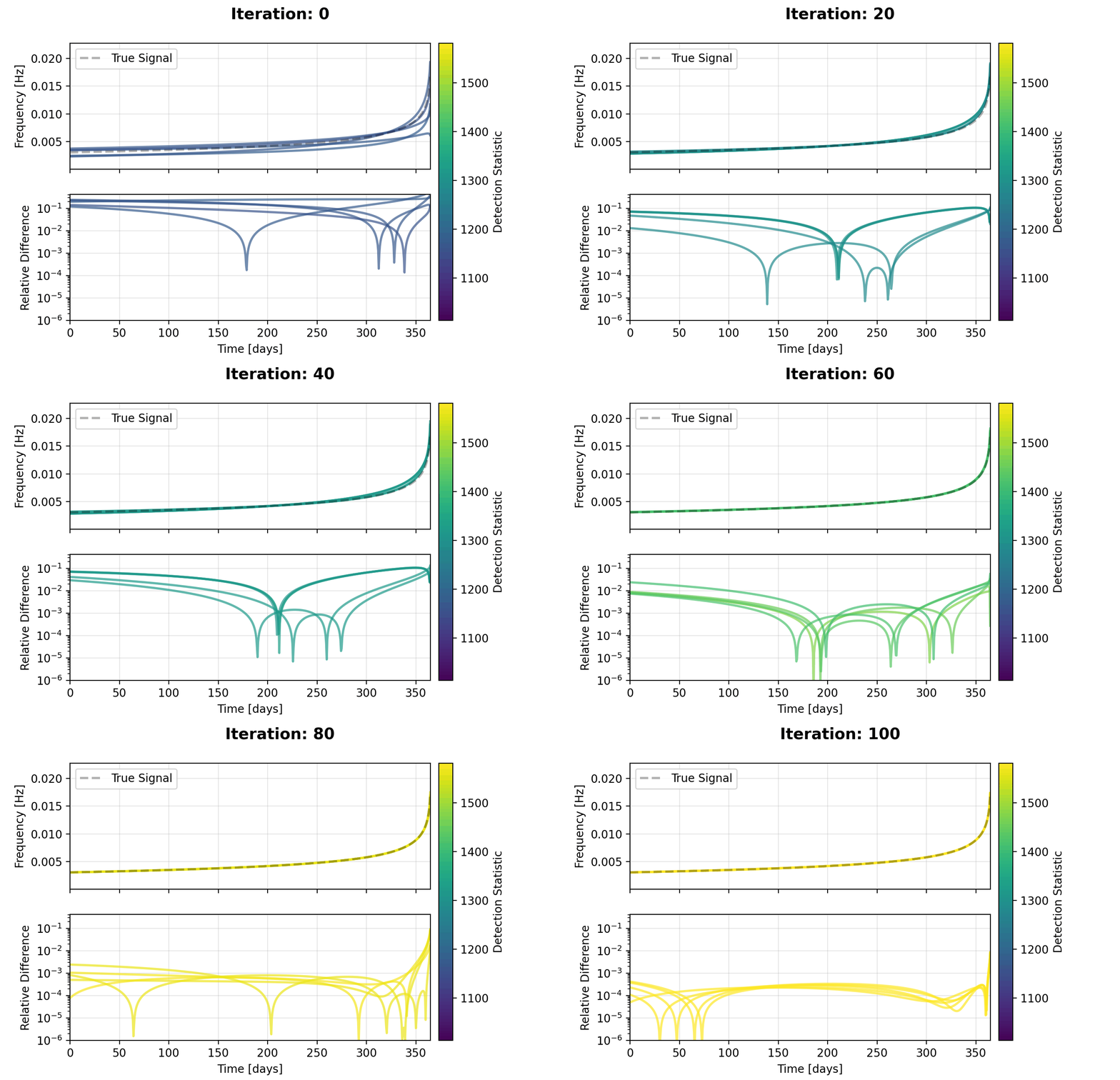
Caption: This animation illustrates the optimization process performed by the EMRI-Search code to recover the frequency evolution of an Extreme Mass Ratio Inspiral (EMRI) signal. The algorithm iteratively adjusts model parameters to best match the observed data, efficiently searching for the true frequency trajectory of the inspiraling compact object. To find out which sources I successfully recovered, click here!